Reviewed · PRIVATE
Captivating DC Private Photography Workshop
Washington’s memorials are familiar sights, but a camera gives you a reason to slow down and notice them differently. This private evening workshop with Brandon J focuses on framing, reflection, symmetry, storytelling, and the emotional weight of places such as the Lincoln Memorial and Vietnam Veterans Memorial.
I like the personal instruction and the mix of technical and human advice. Brandon is described as friendly, calm, and enthusiastic, and you can ask to see his photography portfolio for extra examples. I also like the range of practice: clear reflections at the Reflecting Pool, balanced compositions at the World War II Memorial, and low-light work as the evening progresses.
The main consideration is the $170 per-person price for about two and a half hours. That can be good value for a private lesson, but it makes the most sense if you want hands-on photography help rather than a standard sightseeing walk. The experience also depends on good weather.
Key points about the DC photography workshop
- Private instruction with Brandon J: Your group receives direct guidance rather than sharing the session with strangers.
- Starts at 6:00 pm: The timing lets you work with changing evening light and practice low-light photography.
- Four major photography settings: The route includes the Lincoln Memorial, World War II Memorial, Reflecting Pool and Washington Monument, and Vietnam Veterans Memorial.
- Skills go beyond camera settings: You work on composition, reflections, symmetry, establishing shots, close-ups, details, and visual storytelling.
- A thoughtful approach to memorials: The instruction connects photographic choices with mood, memory, symbolism, and emotion.
- Practical planning matters: Snacks are not included, the tour begins and ends at the Three Servicemen Statue, and free cancellation is available up to 24 hours before departure.
Why this workshop is different from a normal National Mall walk
A regular visit to the National Mall often becomes a checklist: take a picture of the Washington Monument, walk to the Lincoln Memorial, then head back to the hotel. This workshop gives you a clear purpose at each stop. You are not simply collecting proof that you were there. You are learning why one position, lens choice, reflection, or crop may tell the story better than another.
The instruction also has an unusual focus on emotional response. Memorials are designed to make you think and feel, and Brandon’s approach considers how an image can carry that feeling. You may work with symmetry and clean lines in one moment, then shift toward a close-up or a quiet detail that says more than a wide view.
That balance is useful. You get practical photography help without treating the monuments as empty backdrops. The best photographs here often depend on restraint. A simple composition can communicate more than a busy frame filled with every recognizable feature.
This is a private activity, so the pace belongs to your group. That matters if you want to ask repeated questions, compare several compositions, or spend longer on one subject. It also means the value depends on how actively you take part. If you only want someone to point out famous buildings, you may not get your money’s worth.
More photo sessions in Washington DC:
- Private Vacation Photoshoot with Photographer in Washington DC
★ 4.5 · 7 reviews - 1 Hour Private Photoshoot in National Mall
★ 5.0 · 7 reviews
Starting at the Three Servicemen Statue at 6:00 pm
The meeting point is the Three Servicemen Statue at the Vietnam Veterans Memorial, at 5 Henry Bacon Drive NW. The activity begins at 6:00 pm and returns to this same point at the end.
Starting near the Vietnam Veterans Memorial gives the session a serious tone from the first frame. It also places you close to one of the most reflective locations on the route. Since the workshop ends here too, you do not need to arrange a separate pickup point across the Mall.
The listed meeting area is near public transportation, which helps if you are not staying within easy walking distance. A mobile ticket keeps the booking information on your phone. Confirmation arrives when you book.
Bring the camera or phone you actually plan to use. The workshop is designed around your equipment, and the practical lessons will be more useful if you learn with the device you will carry on future trips. Snacks are not included, so bring something if you need food during the two-and-a-half-hour outing.
Lincoln Memorial: framing a familiar icon
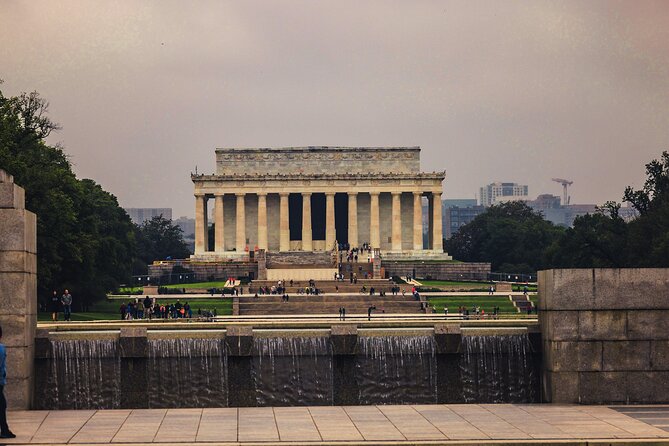
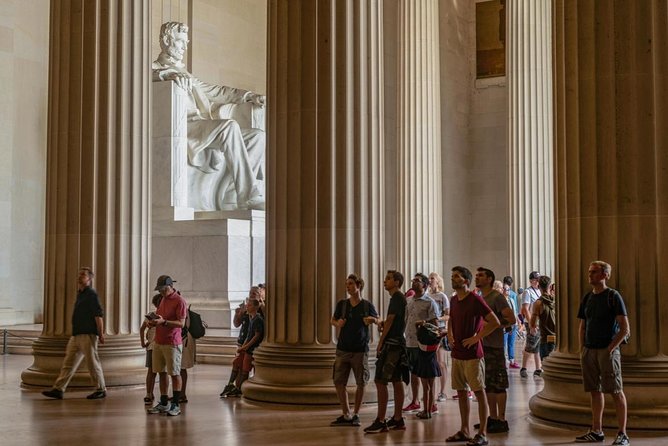
The Lincoln Memorial is an ideal first lesson because it gives you several ways to build a photograph. You can work with the full structure as an establishing shot, then move toward closer views and small details. This helps you understand how a series of images can tell a fuller story than one postcard view.
Brandon guides you through framing and composition at the memorial. You might look at how much of the surrounding space to include, how to keep the structure clear, and how to use the strong lines of the building. The goal is not only to make the image technically neat. It is to decide what you want the viewer to notice first.
The nearby reflecting pool adds another lesson. Clear reflections depend on angle, surface conditions, and the amount of sky and architecture you place in the frame. The Washington Monument appears from this area, but the important part is learning how to position it so the reflection supports the composition instead of becoming a distracting extra.
This is also where the workshop’s storytelling approach becomes useful. A wide shot can explain the setting. A closer view can show architectural detail. A carefully chosen small element can suggest age, memory, or human scale. You learn to make those choices on purpose.
The drawback is that the Lincoln Memorial is one of the Mall’s most photographed places. You will not be working in an untouched scene. The value comes from finding a stronger angle and learning a repeatable method, not from expecting an entirely original subject.
World War II Memorial: balance, movement, and longer exposures
At the World War II Memorial, the focus shifts toward balance and the relationship between people, structures, and open space. The memorial’s formal arrangement gives you a chance to think about symmetry, visual weight, and where the eye travels through a frame.
You also practice long-exposure photography for night work. Since the workshop starts at 6:00 pm, the exact amount of darkness depends on the season and conditions. Still, the evening schedule gives you a useful chance to see how your approach changes as daylight fades.
Long exposures require patience. You need to consider movement, available light, and the way bright areas affect the final image. Brandon can help you understand the decisions behind the shot rather than simply handing you a list of settings. That is important because the right choice changes with the scene.
There is room for street photography here as well. This does not mean treating people as random decoration. It means noticing how human movement, public space, and monumental architecture work together in a photograph. A person walking through the frame can provide scale or motion, while an empty view can feel formal and still.
You may find this part of the workshop especially helpful if you usually photograph only static subjects. The memorials give you structure, while passing movement gives the frame energy. It is a good place to practice making a quick decision before the moment changes.
A few more Washington DC tours worth putting side by side
- Gourmet Pasta Class in Washington D.C. (Includes 3-Course Meal)
★ 5.0 · 5 reviews
Reflecting Pool and Washington Monument: the power of symmetry
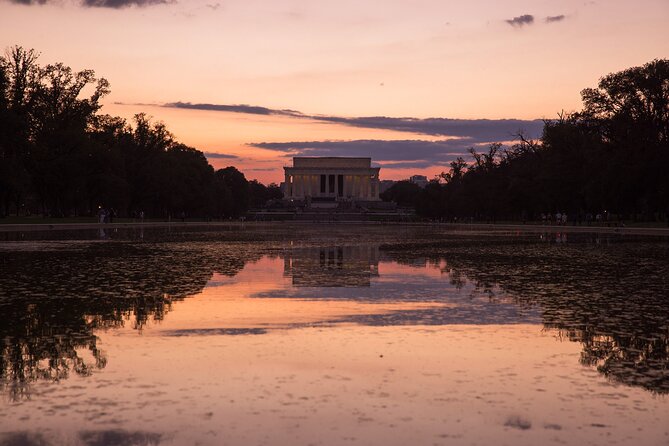
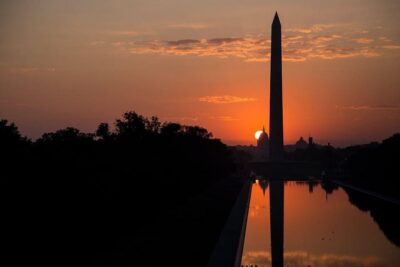
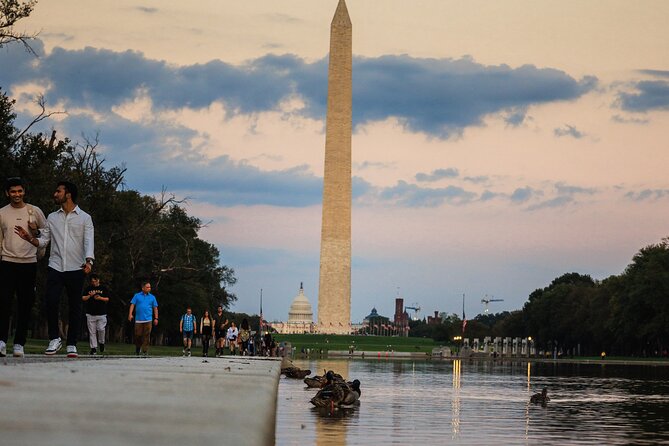
The Reflecting Pool offers one of the clearest visual exercises on the National Mall: place the Washington Monument and its reflection in a balanced frame. It sounds simple, but a strong symmetrical photograph depends on small adjustments in height, position, horizon placement, and timing.
This is one of my favorite parts of the route because the lesson is easy to understand and useful far beyond Washington. Reflections can turn a single subject into a more formal image, but they can also make a photograph feel flat if the composition has no clear point of interest. Brandon helps you consider how much water, sky, and architecture belong in the frame.
The workshop also addresses light on the surface of the pool. As the evening changes, the reflection may take on a different character. You practice responding to the light instead of treating one camera setting as a permanent answer.
The Washington Monument also carries symbolic meaning. It is tied to ideals of leadership and national identity, so the image can work on two levels. You are making a balanced architectural photograph, but you are also deciding how to present a symbol that many people already recognize.
This stop should suit you if you like orderly compositions and want to improve your eye for alignment. It may be less satisfying if you prefer spontaneous, messy, documentary images, although the transition into lower light and street photography adds some variety.
Vietnam Veterans Memorial: reflective surfaces and a quieter mood
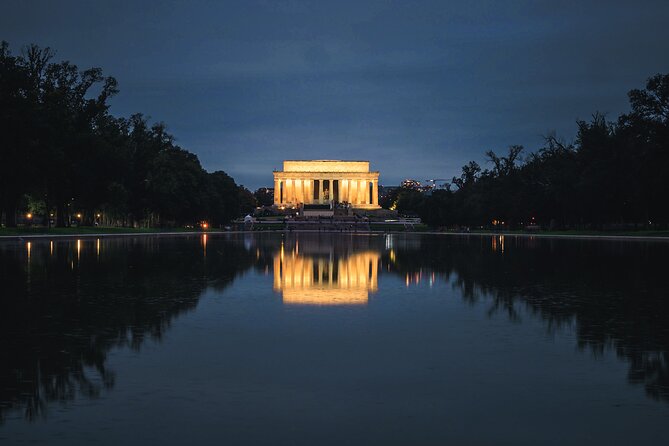
The tour returns to the Vietnam Veterans Memorial, where the photographic task becomes more restrained. The polished surface is central to the experience, both visually and emotionally. You practice photographing reflections while considering the solemn purpose of the memorial.
This is not a place for careless snapping. The setting asks you to pay attention to mood, distance, and personal space. A reflection in the wall can include the surrounding trees, the sky, or a person standing near the names. Each choice changes the emotional weight of the photograph.
The low-light conditions create another technical challenge. Darker scenes can reveal problems with focus, exposure, and unwanted movement. You work on making images that remain clear without losing the quiet feeling of the site.
I appreciate that this stop is not treated only as a photography trick. The reflective surface has meaning. It connects the viewer with the names and with the act of remembering. A strong image here should respect that purpose rather than turn the memorial into a dramatic prop.
Because the tour begins and ends at this location, you may have a better sense of the place when you return. The earlier discussion of reflections and composition can now be applied in a more personal setting. If you want a lighthearted photo walk, this part may feel serious. If you want photography tied to place and memory, it is likely to be the most meaningful section.
Brandon’s teaching style and what you can ask for
The strongest feature of this activity is direct contact with Brandon. His teaching style is described as friendly and reassuring, which can help if you feel uncertain about your camera or worry that your technical questions are too basic.
You can ask to see his Instagram or the photography portfolio stored on his phone. That is a practical tip because examples often explain an approach faster than abstract advice. Look closely at the images and ask why he chose a particular angle, amount of space, or level of detail.
The instruction is not limited to camera mechanics. Brandon also brings an interest in how photographs communicate emotion and ideas. You can expect discussion of the psychology behind images, including why symmetry may feel calm, why reflections can encourage contemplation, and why a close-up may create a stronger connection than a wide view.
Since the activity is private, tell him what you want to improve. You might ask for help with composition, low-light work, reflections, or using a phone camera. The supplied details do not promise a particular camera model lesson, editing session, or finished gallery, so you should think of this as an outdoor shooting workshop rather than a post-processing class.
A group photo is included. That gives you one shared memento, but the main product is the skill you build while making your own images.
Is $170 per person a fair price?
At $170 per person, this is not a budget sightseeing activity. The comparison is not a regular National Mall tour. You are paying for a private session, direct instruction, and a route built around photography rather than general facts about Washington.
The price makes more sense if you already care about photography or want a focused introduction from someone who can respond to your questions in real time. A private lesson can save you from spending hours making the same composition mistakes on your own. It can also help you return to the Mall later with a clearer plan.
The value is weaker if you only want scenic views and a few quick snapshots. The famous memorials are free to visit, and you can walk between them without paying for a guide. You should book this activity for the instruction, not simply for access to the locations.
The group size is another part of the calculation. Only your group participates, so you receive attention that a large workshop may not provide. For a couple, family, or small group with a shared interest in photography, that privacy may justify the cost more easily than it would for someone traveling alone.
Timing, weather, and who should book
The 6:00 pm start is a key part of the experience. You work with daylight first, then move toward lower light and night photography techniques. The exact visual result will change with the season, so do not book expecting the same sky or brightness shown in someone else’s pictures.
Good weather is required. If poor weather cancels the activity, you can choose another date or receive a full refund. You can also cancel for a full refund if you do so at least 24 hours before the start time. Changes or cancellations inside that 24-hour window are not accepted for a refund.
This workshop is a good fit for:
- You want personal guidance instead of a large class.
- You enjoy memorials, architecture, and visual storytelling.
- You want to improve reflections, symmetry, framing, or low-light work.
- You are comfortable walking between major National Mall sites while carrying your camera or phone.
- You like asking questions and trying several versions of a photograph.
It may not suit you if you want a general history tour, indoor shelter from changing weather, or a short stop with no technical instruction. Snacks are not provided, and the evening schedule may be less appealing if you prefer daytime photography.
Service animals are allowed, and most people can participate. The meeting point is near public transportation, which makes the start and finish fairly practical.
Should you book the Captivating DC Private Photography Workshop?
Book it if you want to turn a visit to Washington’s memorials into a real photography lesson. The route covers several strong subjects, but the best reason to choose it is the private guidance from Brandon J. His friendly manner, willingness to show his own portfolio, and focus on both technique and emotion give the workshop more purpose than a simple photo walk.
The price is reasonable for a private two-and-a-half-hour session if you will actively practice and ask questions. It is harder to justify if you only want someone to lead you around the Mall. Bring the camera you use most, arrive ready to walk and experiment, and keep an eye on the weather before departure.
FAQ
Where does the photography workshop begin?
It begins at the Three Servicemen Statue at the Vietnam Veterans Memorial, 5 Henry Bacon Drive NW, Washington, DC 20004.
What time does the activity start?
The workshop starts at 6:00 pm.
How long does the workshop last?
The activity lasts approximately two hours and 30 minutes.
Is this a private tour?
Yes. Only your group participates in the activity.
What should I bring?
Bring the camera or phone you want to use for photography. Snacks are not included, so bring any food or drinks you want during the workshop.
What happens if the weather is poor?
The experience requires good weather. If it is canceled because of poor weather, you will be offered another date or a full refund. You can also cancel up to 24 hours before the start time for a full refund.
Just added in Washington DC
- Washington DC: Highlights Guided Walking Tour★ 4.6 · 6 reviews
- Washington DC: Private Custom Tour with a Local Guide★ 4.9 · 4 reviews
- Washington, DC: Thanksgiving Day Lunch Cruise★ 4.7 · 3 reviews
- Washington: Mt. Vernon, Alexandria & Arlington Cemetery Tour★ 3.4 · 8 reviews
- Washington D.C.: The Ghosts of Washington D.C. Walking Tour★ 4.6 · 14 reviews
- Thomas Jefferson Monticello Small Group Day Tour from DC★ 4.8 · 16 reviews
- Washington, DC: The Good Liar: Brian Curry★ 5.0 · 3 reviews
- From NYC: Washington DC 1 Day Tour and Free Time for Museums★ 4.4 · 5 reviews
Private, compared.
National Mall Night Tour with 10+ Monuments (Public or Private)
Read our review →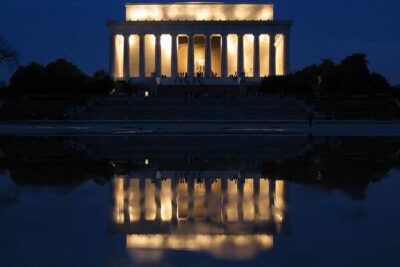
Private Night-Time Monuments Tour of DC for up to 10 Guests
Read our review →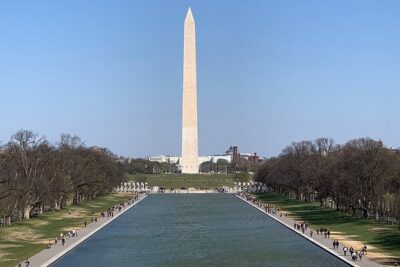
Private Multilingual DC City Tour (Spanish, Portuguese, English)
Read our review →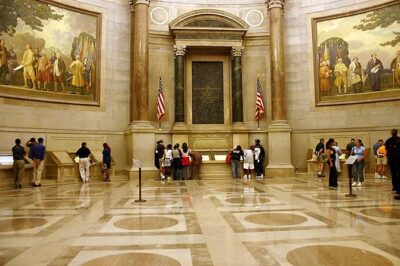
National Archives Skip the Line Guided Tour Semi-Private 6ppl Max
Read our review →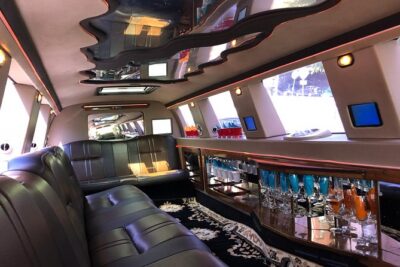
Private Washington DC Tour with Changing of the Guard Ceremony
Read our review →
Smithsonian Air & Space Museum Guided Tour Semi-Private 8ppl Max
Read our review →