Reviewed · TOURS
We the People Tour: The Essence of Liberty
Washington has enough monuments to fill several days, but this four-hour tour packs the city’s main civic and memorial sights into one morning. You move from the Capitol and White House to the National Mall, then finish with time inside the National Archives. Guides associated with the company include Brian McCauley and Danny.
I like the wide range of stops, especially the shift from grand government buildings to quiet memorials such as the Vietnam Veterans Memorial. I also like the practical attention to comfort, including close access to each monument and help for visitors who may have trouble walking long distances. The drawback is clear: fifteen minutes at most memorials is enough for an introduction, not a full visit.
Key points to know before booking

- Nine major sights in about four hours: You cover the Capitol, White House, five major memorials, and the National Archives.
- The National Archives gets the longest visit: Plan on about 90 minutes to see the institution’s major displays.
- A guide adds the city context: Brian McCauley and Danny are named guides connected with the operation.
- Short monument stops keep the pace brisk: Each of the first eight stops is scheduled for about 15 minutes.
- Front-door access helps older visitors: The tour can be useful for families with limited mobility.
- The outing begins at 10 a.m.: The meeting point is 701 15th Street NW, with the tour ending elsewhere.
Why this tour works for a first morning in Washington
The best feature here is the route’s range. In one outing, you see the institutions that run the country, the memorials that explain its wars, and the documents that shaped its government.
That makes this more than a monument checklist. The Capitol introduces the legislative branch. The White House represents executive power. The National Archives brings the story back to the founding documents and official records that give those institutions their authority.
You will not have much time to linger at the outdoor stops. That is the trade-off. A quick stop can give you orientation and a good look, but it cannot replace a slow walk around the Vietnam Veterans Memorial or a careful reading of the inscriptions at the Lincoln Memorial.
The format suits you if you want help getting your bearings fast. It also works well if you have only one day in Washington and want to see the major sights before deciding where to return on your own.
The tour has a maximum group size of 56 people. That is not an intimate walking seminar, but it is still small enough to keep the group manageable if the guide is organized. The strongest praise centers on the personal care provided by guides, especially Brian McCauley, who is described as energetic, flexible, and attentive even in rainy weather.
Other Washington DC tours people book alongside this one:
- DC Memorials Night Tour: Glass-Roof Convertible Upgrade Option
★ 4.5 · 6,933 reviews - National Mall Monuments Night Tour with 10+ Stops, Entry Tickets
★ 4.5 · 4,863 reviews - Washington DC Monuments by Moonlight Tour by Trolley
★ 4.5 · 3,956 reviews
Capitol Hill and the White House
The morning begins at 701 15th Street NW at 10 a.m., then moves to the United States Capitol. The Capitol sits at the eastern end of the National Mall and houses Congress, the federal government’s legislative branch.
A short stop here gives you the essential setting. The building also serves as the starting point for Washington’s street-numbering system and the city’s four quadrants, a useful detail when you are trying to understand the capital’s layout.
The visit is listed at 15 minutes, with admission included at no extra charge. Do not expect a full interior tour during this outing. The value comes from seeing the building in context and hearing why Capitol Hill matters.
The White House follows, also for about 15 minutes. At 1600 Pennsylvania Avenue NW, it has served as the home and workplace of every president since John Adams in 1800.
You will view the building from the outside on this itinerary. That still gives the guide a chance to explain the difference between the president’s residence, office, and wider administration. The White House is also a useful counterpoint to the Capitol: one represents the executive branch, the other the legislative branch.
The two stops work well together. If you are new to Washington, they give you a basic political map before the tour turns toward memorials and national memory.
The World War II Memorial and Jefferson Memorial
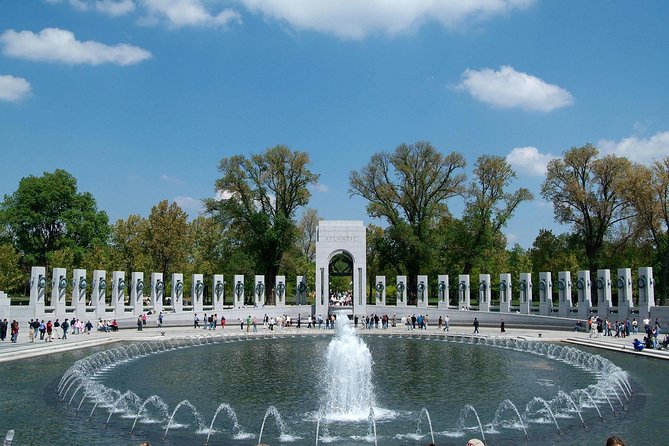
The National World War II Memorial sits on the National Mall between the Washington Monument and the Lincoln Memorial, at the former site of the Rainbow Pool. Its design includes 56 pillars, two triumphal arches, a square pool, and fountains.
The stop lasts about 15 minutes. That is enough to see the broad design and understand that the memorial honors both military personnel and civilians who served during World War II. You may want extra time later to read the inscriptions and take in the full arrangement of the pillars.
Next comes the Jefferson Memorial, dedicated to Thomas Jefferson, the principal writer of the Declaration of Independence and the third president of the United States. The memorial’s setting beside the Tidal Basin gives it a quieter feel than the central Mall.
This is one of the places where a guide can add real value. Jefferson’s public role touched the Declaration, the early federal government, diplomacy, the presidency, and the founding of the University of Virginia. A short explanation can help you connect the memorial’s ideals with the complicated life of the man it honors.
Again, the scheduled 15 minutes is a sampler. You will see the memorial, get its main context, and move on. If you want time for close reading or photography, mark this as a place to revisit.
Martin Luther King Jr. Memorial and the Korean War Memorial
The Martin Luther King Jr. Memorial occupies four acres in West Potomac Park. Its central feature is the Stone of Hope, a granite statue of King carved by Lei Yixin.
The design comes from a line in King’s I Have a Dream speech about moving from a mountain of despair toward a stone of hope. The memorial opened to the public in 2011 after more than two decades of planning, fundraising, and construction.
The 15-minute stop gives you time to see the statue and understand the design’s central idea. It also places King’s work within the same national memorial area as presidents and military conflicts. That physical connection matters. The Mall is not only a collection of buildings and statues. It is also a record of how the United States chooses to remember struggle and change.
The Korean War Veterans Memorial is also scheduled for 15 minutes. Located southeast of the Lincoln Memorial and south of the Reflecting Pool, it honors those who served in the Korean War.
This stop has a different tone from the presidential memorials. The focus is on service and sacrifice, and the memorial’s placement near the Lincoln and Vietnam sites creates a strong sequence of twentieth-century American memory.
Admission is included here, as it is at the National Archives. The outdoor memorial stops do not require separate tickets, but the guide’s explanations help you understand why each site exists and how it fits into the larger Mall.
A completely different kind of day in Washington DC:
- Hop-on Hop-off Sightseeing Tour by Open-top Bus with 18 Stops
★ 3.5 · 3,848 reviews - Washington DC in One Day: Guided Sightseeing Tour
★ 4.5 · 3,360 reviews - DC Monuments and Capitol Hill Tour by Electric Cart
★ 5.0 · 2,841 reviews - Washington DC Moonlight Tour by Electric Cart
★ 5.0 · 2,610 reviews
Lincoln Memorial and the Vietnam Veterans Memorial

The Lincoln Memorial sits at the western end of the National Mall, facing the Washington Monument. It honors Abraham Lincoln, the 16th president, and has been a major public gathering place since its dedication in 1922.
You get about 15 minutes here. That allows time to climb the steps, see Daniel Chester French’s Lincoln statue, and look across the Mall. The memorial has also become a major symbol in the country’s continuing discussion of race and civil rights.
The short stop can feel rushed, especially if the steps are crowded. Still, a guide can point out the memorial’s place in public life and connect it with the nearby Martin Luther King Jr. Memorial.
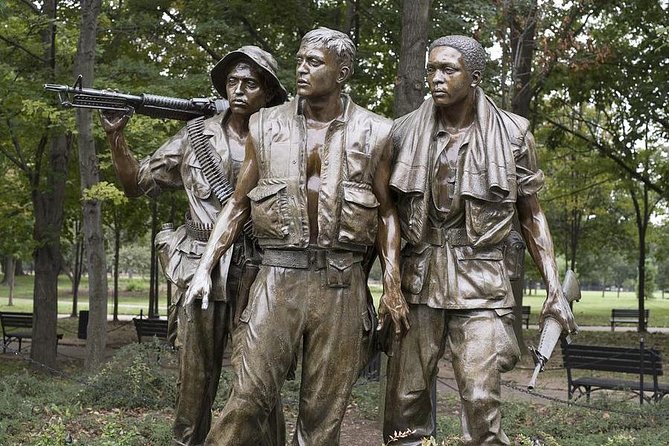
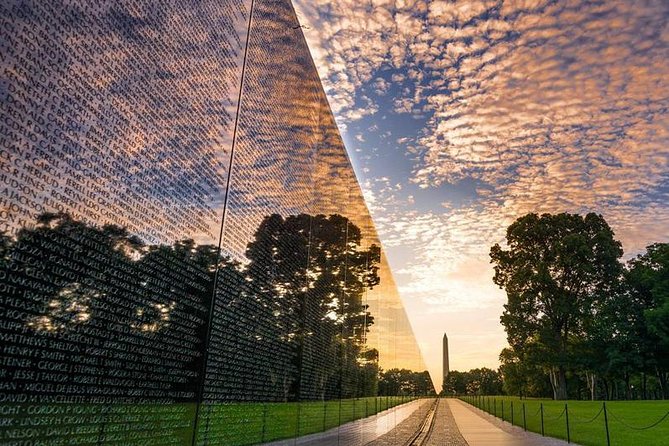
The Vietnam Veterans Memorial follows. Its best-known feature is the Wall, which lists the names of service members who died in or remain unaccounted for from the Vietnam War and related service in Southeast Asia. The memorial also includes The Three Soldiers and the Vietnam Women’s Memorial.
This is the stop where extra personal care matters most. Brian McCauley is specifically praised for helping a couple make an etching of a childhood friend’s name and respectfully sharing the moment with them. That detail tells you something useful about the tone of the experience. The guide is not only delivering facts and moving people along. He can also recognize when a site has personal meaning.
You should know that a 15-minute visit may only allow a first look at the Wall. If you have a particular name to find, prepare in advance and tell the guide as soon as possible. The memorial can be emotionally heavy, and the pace may feel too quick for people who want to walk the full length or spend time at several names.
Ninety minutes at the National Archives

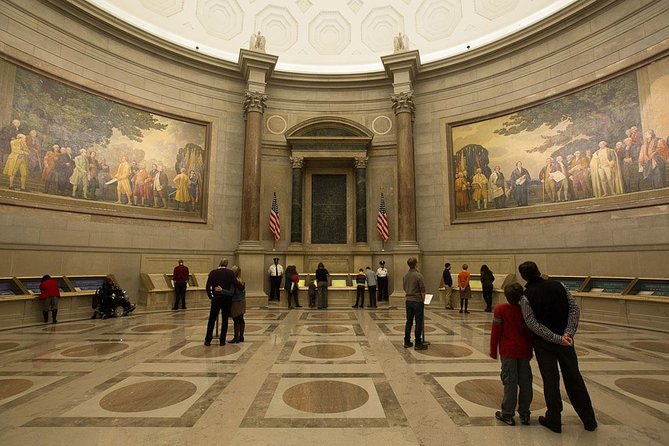
The National Archives Museum is the final major stop and receives about 90 minutes, far longer than any individual memorial. This is a smart use of time because the museum rewards close attention.
The National Archives and Records Administration preserves and provides access to official government records. It maintains legally authentic copies of acts of Congress, presidential directives, federal regulations, and Electoral College records sent to Congress.
The museum gives the tour a strong finish. After seeing the buildings and memorials that express national ideals, you get time with the records that shaped those ideals in law and government.
The exact exhibits available can change, so the supplied details do not promise a specific display list. You can expect the Archives portion to be the most substantial indoor visit of the day, with enough time to move at your own pace inside the museum.
This longer stop also balances the brisk outdoor schedule. If the memorials leave you wanting more detail, the Archives gives you room to pause. If you prefer buildings and original documents to outdoor statues, this may be the part of the experience you value most.
Guide quality and the human side of the tour
The guides are central to the tour’s value. Brian McCauley is singled out for energy, humor, local knowledge, and the ability to adjust to what a group wants to see. Danny is also named as someone who works thoughtfully with families.
That matters because the route is ambitious. You need a guide who can explain the important point at each stop without turning every location into a lecture. You also need someone who can keep the timing under control.
The personal service is especially useful for older visitors. One family traveling with 80-year-old parents received close access to each monument, making it easier for them to enjoy the sites without unnecessary walking. The tour may be a good choice if your group includes someone who cannot comfortably cover long stretches of the Mall.
Service animals are allowed, and the activity is near public transportation. Most people can participate, according to the supplied tour information. Still, the pace, outdoor exposure, stairs, and 15-minute stops are worth considering for anyone with limited stamina.
Timing, transport, and value

The tour lasts about four hours and begins at 10 a.m. It ends in a different location, so you should not plan on returning to the starting point unless you arrange your own transportation.
One option gives you extra time at the location you prefer, but you must provide your own ride back to your hotel. That flexibility can be useful if you want to remain near the National Archives, Lincoln Memorial, or another final stop.
The supplied information does not give a ticket price, so I cannot judge the exact cost. The value depends on what you would otherwise spend on transportation, planning time, and separate explanations at nine major sites.
For a first visit, a guided route can save you from piecing together the Mall on your own. The strongest value comes from the combination of door-to-door convenience, local explanation, and the ability to see far more in one morning than you might manage independently.
The trade-off is depth. You pay for breadth and ease, not long museum visits or unhurried memorial walks. If you already know Washington well, you may prefer choosing two or three sites and spending the whole day with them.
Group discounts are available, and the mobile ticket makes booking simple. The tour requires a minimum number of participants, so cancellation is possible if that minimum is not met. Poor weather can also cancel the experience. You can cancel for a full refund up to 24 hours before the start time, but changes or cancellations inside 24 hours are not refunded.
Who should book this Washington tour
I would choose this tour for a first-time visitor, a family with limited time, or anyone who wants a clear introduction before exploring Washington independently.
It is also a sensible pick for families with older parents. The close access to monuments and the guides’ willingness to accommodate the group can make a real difference.
I would be more cautious if your main goal is quiet reflection. Fifteen minutes at the Vietnam Veterans Memorial, Lincoln Memorial, or Jefferson Memorial may not be enough. You should also think twice if you dislike group outings or prefer setting your own pace at every stop.
The National Archives gives the tour a useful anchor, and the route covers the major symbols of Washington without requiring you to plan every transfer. Just accept that this is a fast overview, not a full study of each monument.
Should you book We the People Tour?
Book it if you want the big Washington picture in one organized morning, with a guide who can add context and help your group manage the city’s long distances.
The best reasons are the broad route, the 90-minute Archives visit, and the thoughtful service associated with guides such as Brian McCauley and Danny. The main warning is the pace. You will see nine important places, but you will need to return on your own to the sites that deserve more time.
For a first visit, that is often a fair trade. Use this tour to learn the city’s layout, identify your priorities, and then spend a later afternoon revisiting the memorial that spoke to you most.
FAQ
How long is the We the People Tour?
The tour lasts approximately four hours.
What time does the tour start?
The tour starts at 10:00 a.m.
Where does the tour begin?
It begins at 701 15th Street NW, Washington, DC 20005.
Where does the tour end?
The activity ends at a different location from the starting point. The supplied information does not provide a specific ending address.
Which places does the tour visit?
It visits the United States Capitol, White House, National World War II Memorial, Jefferson Memorial, Martin Luther King Jr. Memorial, Korean War Veterans Memorial, Lincoln Memorial, Vietnam Veterans Memorial, and National Archives Museum.
How much time is spent at the National Archives?
The National Archives portion lasts about one hour and 30 minutes.
Can I cancel for a refund?
Yes. You can cancel at least 24 hours before the experience start time for a full refund. Cancellations or changes made less than 24 hours before the start time are not refunded.
Just added in Washington DC
- Washington DC: Highlights Guided Walking Tour★ 4.6 · 6 reviews
- Washington DC: Private Custom Tour with a Local Guide★ 4.9 · 4 reviews
- Washington, DC: Thanksgiving Day Lunch Cruise★ 4.7 · 3 reviews
- Washington D.C.: The Ghosts of Washington D.C. Walking Tour★ 4.6 · 14 reviews
- Thomas Jefferson Monticello Small Group Day Tour from DC★ 4.8 · 16 reviews
- Washington: Mt. Vernon, Alexandria & Arlington Cemetery Tour★ 3.4 · 8 reviews
- From NYC: Washington DC 1 Day Tour and Free Time for Museums★ 4.4 · 5 reviews
- Washington, DC: The Good Liar: Brian Curry★ 5.0 · 3 reviews
Tours, compared.

DC Memorials Night Tour: Glass-Roof Convertible Upgrade Option
Read our review →
National Mall Monuments Night Tour with 10+ Stops, Entry Tickets
Read our review →
Washington DC Monuments by Moonlight Tour by Trolley
Read our review →
Hop-on Hop-off Sightseeing Tour by Open-top Bus with 18 Stops
Read our review →
Washington DC in One Day: Guided Sightseeing Tour
Read our review →
Washington DC Moonlight Tour by Electric Cart
Read our review →
Washington DC Hop-On Hop-off Trolley Tour with 15 Stops
Read our review →