
Reviewed · LINCOLN MEMORIAL TOURS
Night of Lincoln Assassination: from White House to Ford Theatre
Lincoln’s final day becomes far more vivid when you follow it on foot, from the White House area to the theater where John Wilkes Booth fired the fatal shot. This two-hour evening walk links familiar Washington streets with the people and places caught up in the plot.
I like the small group size, capped at 15, and the way guides use historical photographs to show how Civil War-era Washington looked. I also like the manageable distance and the useful finish outside Ford’s Theatre. The main drawback is simple: you do not enter any buildings, and cold, rain, or heat can make an outdoor tour less comfortable.
Key points to know before you book
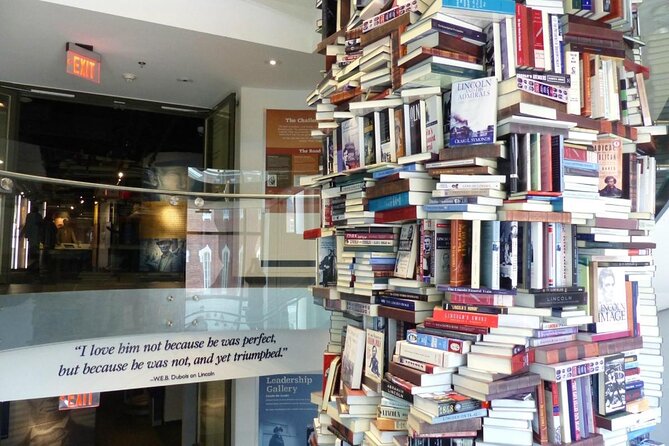
- The story follows one night on foot: You cover about one mile, from St. John’s Episcopal Church to Ford’s Theatre.
- The White House is part of the story, not the tour interior: You stop outside and discuss Lincoln’s presidency and final speech.
- Period photographs help set the scene: Guides use images of Washington and the people tied to the assassination.
- Ford’s Theatre tickets are not included: The tour ends outside, with no entrance to the theater or Petersen Boarding House.
- Guide quality shapes the experience: Becca, Katherine, Trevor, Rebecca, Wesley, Cecilia, Emma, and Jim have all led especially engaging walks.
- The outdoor setting matters: Wear shoes for city walking and dress for the forecast, particularly for the 7:00 pm departure.
Following Lincoln’s last day through downtown Washington
This is not a museum tour with a string of display cases. It is a moving history lesson. You walk through the city where Lincoln spent his final hours, stopping at buildings connected to the assassination plot and the people around the president.
The route begins outside St. John’s Episcopal Church at 1525 H Street NW and ends outside Ford’s Theatre at 511 10th Street NW. The walk is roughly one mile, though the full experience takes about two hours because the guide pauses often to explain the setting and the characters.
That slow pace is the point. The assassination is easy to reduce to one famous name, one gunshot, and one theater box. On this walk, you get the wider picture: Lincoln’s final months in office, John Wilkes Booth’s movements, the threat against Vice President Andrew Johnson, the role of theaters and hotels, and the desperate hours after the shooting.
You should expect an outdoor talk rather than a formal theater visit. The guide carries the history, often using photographs on a tablet or in printed form. Strong guides also add sound effects, vivid details, and clear explanations of how the city worked in 1865.
More Lincoln Memorial tours in Washington DC:
- Lincoln Assassination with Ford’s Theatre & Petersen House Entry
★ 5.0 · 444 reviews - DC: White House, National Mall and Lincoln Memorial Tour
★ 4.1 · 279 reviews - Bike Tour: Capitol Hill, Lincoln Memorial, National Mall
★ 4.6 · 69 reviews
Starting at St. John’s, the Church of the Presidents
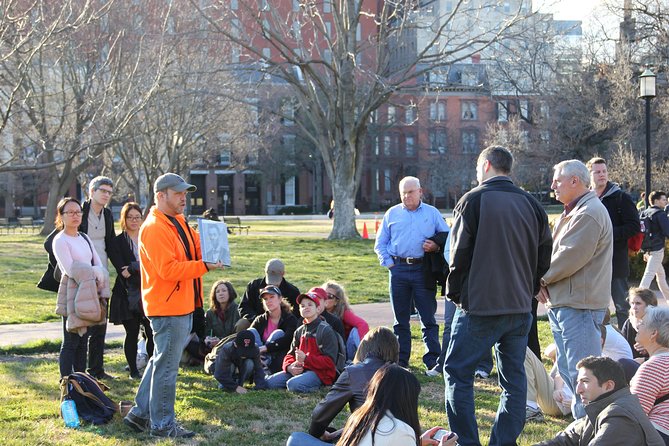
St. John’s Episcopal Church provides a useful opening because it helps place you in Washington during the Civil War. The church is nicknamed the Church of the Presidents, and the guide uses the setting to explain the city and the political pressures surrounding Lincoln’s final months.
You do not enter the church. The stop lasts about five minutes, so it is less about seeing the interior and more about getting your bearings before the story begins.
I like this kind of start because the subject can otherwise feel oddly detached from modern Washington. At St. John’s, the guide begins with the city itself, then moves toward Lincoln’s final day. You learn to look past today’s traffic and office buildings and imagine a smaller capital shaped by war, politics, and personal rivalries.
Lafayette Square and Lincoln’s White House years
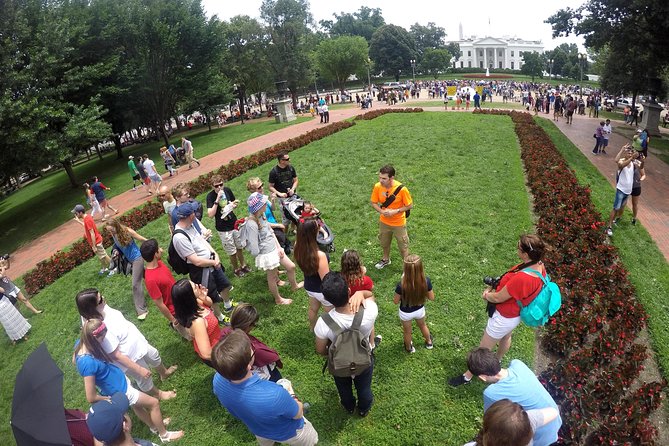
The next stop is Lafayette Square, where historic row houses frame the opening section of the story. Here you hear about Lincoln’s final months in the White House and meet some of the people connected to the night of April 14, 1865.
The houses around the square are not just decorative backdrops. They help show where influential Washington residents lived and how close political life was to the White House. The guide introduces characters as you walk, making the assassination plot feel less like an isolated event and more like a chain of people, decisions, and missed chances.
You then stop outside the White House. The tour does not include entry, and the White House admission is not part of the $49 price. Instead, the guide discusses Lincoln’s presidency during the Civil War and his final speech, given at the White House in the presence of John Wilkes Booth.
That detail gives this stop its weight. Booth was not a distant figure who knew Lincoln only from newspaper accounts. He had seen the president in person. The guide uses that connection to show how political conflict, public appearances, and personal grievance came together.
The White House stop lasts about ten minutes. It works best if you want context, not an interior tour. If your main goal is to see rooms associated with Lincoln, you will need a separate visit elsewhere.
Walking past the Treasury and into the assassination story
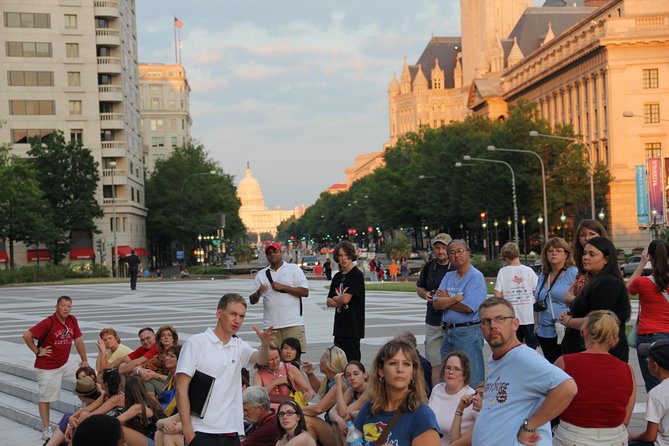
From the White House, the route continues past the U.S. Treasury Building. The guide explains how the Treasury served as a temporary White House after Lincoln’s assassination.
This is the sort of small fact that adds scale to the story. The government had to keep functioning while the president lay dying, and Washington’s familiar buildings took on new roles during the crisis.
You then follow Pennsylvania Avenue, known as America’s Main Street, through downtown Washington. The guide connects the avenue with inaugural parades and everyday movement in Civil War-era Washington. It is also a practical stretch of the walk, with the story unfolding as you move between locations.
Expect city sounds and distractions. Motorcades, traffic, summer heat, rain, and other evening activity can interrupt the guide. A patient guide can work around those problems, but you should not expect a silent setting or a theatrical stage. The city is part of the experience, for better and worse.
More White House tours in Washington DC:
- White House and National Mall Highlights with Lincoln Memorial
★ 4.0 · 38 reviews - White House at Night: Scandals, Murder, Politics Adults Only Tour
★ 5.0 · 13 reviews - Sweet and Savory Scandalous White House Walking Food Tour
★ 4.5 · 12 reviews - America’s Main Street and White House Private Full-Day Tour
★ 5.0 · 3 reviews
The National Theatre and the wider conspiracy
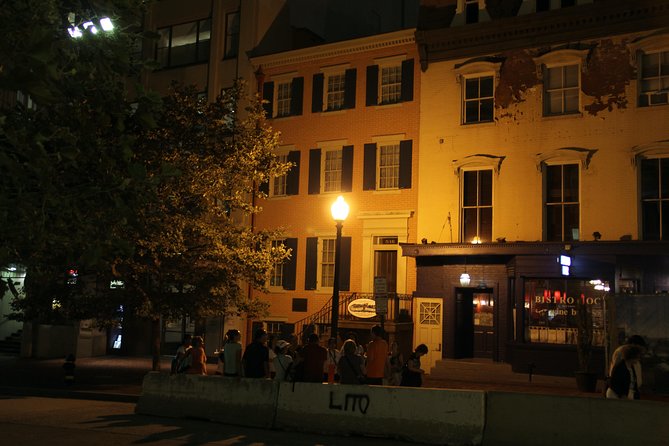
The National Theatre offers one of the more surprising stops. On the day of the assassination, Booth stopped at the theater and met a friend. Later that evening, Lincoln’s son Tad watched a production of Aladdin or his Wonderful Lamp there.
Again, you remain outside. The stop takes about ten minutes, and the value comes from the connections the guide draws between the theater, Booth, Tad, and the evening’s divided movements.
The assassination is often told as if everyone involved gathered in one place. They did not. This stop helps you see the city as a network of separate rooms, hotels, theaters, and streets. People were carrying out different plans, watching different performances, or simply trying to spend an ordinary evening while an extraordinary crime was taking shape.
For families, this can add a useful human angle. Tad’s presence reminds you that Lincoln’s family was still living through the ordinary rhythms of a night out while the president was facing danger elsewhere.
The Old Post Office and the threat to Andrew Johnson
At the Old Post Office Pavilion, the guide points across the street to the former location of the Kirkwood House Hotel. Vice President Andrew Johnson was staying there, and conspirator George Atzerodt rented a room at the hotel.
Atzerodt had been assigned to attack Johnson that same night. The stop lasts only about five minutes, but it expands the story beyond Lincoln. The assassination plot involved more than Booth and the president. Other targets and planned attacks were part of the same violent effort.
You do not enter the Old Post Office or any other building on this tour. The site works as an outdoor reference point, with the guide showing how close the locations were to one another and explaining the assignments tied to the plot.
This is one reason the guide’s command of the material matters. A basic Lincoln tour can stop with Booth. A stronger one explains the wider plan and the people who were supposed to strike elsewhere.
Ford’s Theatre and the fatal shot
The walk ends at Ford’s Theatre, the emotional center of the route. The guide discusses how Booth approached Lincoln and fired the shot while the president watched the performance.
The theater is still a working venue and has been restored to its Civil War-era appearance. But this tour does not take you inside, and Ford’s Theatre admission is not included. If you want to see the theater box and the interior exhibits, you must arrange a separate visit through the National Park Service.
That distinction matters when you compare the $49 price with other Washington experiences. You are paying for a guided walking narrative, not for entry to the historic site. The advantage is that you get the streets, buildings, and wider context first. A separate theater visit can then feel more meaningful because you understand what happened before and after the shot.
The exterior stop lasts about 15 minutes. Your guide may use photographs to help you picture the theater and the people inside it. The setting can be crowded and noisy, but arriving in the evening gives the stop a fitting mood, especially when many indoor museums have closed.
Petersen Boarding House and the desperate hours after the shooting
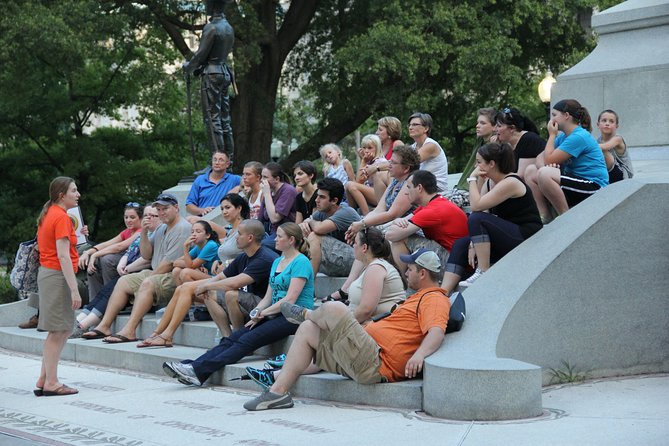
Across from Ford’s Theatre is Petersen Boarding House, where Lincoln was carried after he was shot. He was placed in a first-floor room while doctors attended to him.
The building is small and plain. That plainness is part of the impact. This was not a grand hospital or a presidential suite. It was a boarding house where doctors, officials, witnesses, and family members gathered during the long night.
The guide explains how Secretary of War Edwin Stanton questioned witnesses there. Robert Todd Lincoln came from the White House and remained with his father. Early the next morning, Lincoln’s body was carried down the steps and taken by carriage back to the White House.
You do not enter Petersen Boarding House. The stop lasts about ten minutes, and the guide keeps the focus on the sequence of events rather than treating the building as a quick photo stop.
The route also reaches the original alley behind Ford’s Theatre, the path Booth used to escape. The alley is open to the public, but the tour ends outside Ford’s Theatre, so you should ask the guide how to walk there afterward if you want to see it. Some original buildings remain in the area.
What the guides do best
The best part of this experience is the delivery. Guides such as Becca, Katherine, Trevor, Rebecca, Wesley, Cecilia, Emma, and Jim have received especially strong praise for making a familiar story feel immediate.
Becca is repeatedly described as energetic, well prepared, and able to keep people engaged even on bitterly cold or snowy nights. Katherine has handled distractions such as motorcades, heat, and busy evening activity with patience. Trevor has been praised for packing the walk with facts while keeping it fun.
Jim’s tour ran longer than two hours because of road closures, but the extra time was used to keep the route moving and the story intact. That is useful to know if you have a hard deadline afterward. City events can affect the timing.
Guides use photographs to show people and places from the 1800s. Some also use sound effects and an animated delivery. This can make the tour more entertaining, but it will not suit everyone. If you prefer a quiet, academic lecture, the performance style may feel a little lively. If you want a clear story with memorable details, it is a strong fit.
Is $49 a fair price?
At $49 per person, the value depends on what you want from Washington’s Lincoln sites. The price does not include admission to Ford’s Theatre, and no building entry is included. You are paying for the guide, the route, the historical photographs, and the way the separate locations are tied together.
That is fair if you would otherwise walk past these buildings without understanding their links. The guide saves you from piecing together the story on your own and adds the wider context of Civil War Washington.
The value is also helped by the small group cap of 15. A guide can usually be easier to hear and more responsive in a group of that size than in a large crowd. The tour is recommended by 95 percent of bookers and has a 4.8 rating from 231 ratings, which supports the idea that the storytelling is a major part of what you are buying.
I would pair this walk with a separate Ford’s Theatre visit if Lincoln is a main reason for your Washington trip. If you already know the subject well, the sites and physical route may still add perspective, but one person found the information too familiar. Your enjoyment will depend heavily on how much you value place, atmosphere, and storytelling.
Who should take this evening walk?
I would recommend it to first-time Washington visitors, families with older children, couples, and anyone who likes history presented as a story rather than a list of dates. It can also work well for people who have already read about Lincoln and want to see how the locations relate to one another.
The route is short enough for most people, and most participants can take part. Service animals are allowed, and the meeting point is near public transportation.
Plan for the weather. A snowy or rainy evening does not automatically ruin the tour, but you need a coat, comfortable shoes, and protection from rain when needed. Cold weather has been a real factor on some departures, and summer evenings can bring heat and city noise.
The tour is offered in English and starts at 7:00 pm. It is a good choice for an evening when museums are closed, but do not schedule a tight dinner reservation immediately afterward. The route usually lasts around two hours, and road closures or city events can make it longer.
Should you book the Lincoln assassination walking tour?
Book it if you want the full chain of events, from Lincoln’s White House to Booth’s escape route, and you appreciate a guide who can tell a story with energy. The photographs, small group, short walking distance, and outdoor access to the actual streets make the experience more than a simple stop at Ford’s Theatre.
Skip it if you mainly want to go inside Ford’s Theatre or Petersen Boarding House. This tour does not include either interior, so you will need a separate National Park Service ticket for Ford’s Theatre.
For most history-minded visitors, I would book the walk and add the theater visit separately. Cancel at least 24 hours before the 7:00 pm start for a full refund. Within 24 hours, the price is not refunded, so check the weather and your schedule before the cutoff.
FAQ
How long is the Night of Lincoln Assassination tour?
The tour lasts about two hours. The walking distance is roughly one mile, or 1.6 kilometers.
Where does the tour begin?
It begins outside St. John’s Episcopal Church at 1525 H Street NW, Washington, DC 20005.
Where does the tour end?
The tour ends outside Ford’s Theatre at 511 10th Street NW, Washington, DC 20004.
What time does the tour start?
The scheduled start time is 7:00 pm.
Does the tour enter Ford’s Theatre?
No. The tour remains outside all buildings, including Ford’s Theatre. Admission to Ford’s Theatre is not included.
Are tickets to Ford’s Theatre included in the price?
No. Ford’s Theatre tickets must be obtained separately through the National Park Service.
Is the tour offered in English?
Yes. The experience is offered in English.
What is the cancellation policy?
You can cancel at least 24 hours before the start time for a full refund. Cancellations or changes made less than 24 hours before the experience are not refunded or accepted.
More Evening Tours in Washington DC
- DC Memorials Night Tour: Glass-Roof Convertible Upgrade Option
★ 4.5 · 6,933 reviews - National Mall Monuments Night Tour with 10+ Stops, Entry Tickets
★ 4.5 · 4,863 reviews - National Mall Night Tour with 10+ Monuments (Public or Private)
★ 4.5 · 2,207 reviews - Small Group National Mall Night Tour with 10 Top Attractions
★ 5.0 · 1,658 reviews
Just added in Washington DC
- Washington DC: Express Morning or Night-Time Monuments Tour★ 3.2 · 3 reviews
- Washington, DC: Georgetown Architecture Walking Tour★ 5.0 · 8 reviews
- Washington D.C.: Georgetown Guided Secret Food Tour★ 3.9 · 7 reviews
- Washington DC: E-Bike Rental★ 4.3 · 7 reviews
- Washington DC: Christmas Eve Gourmet Brunch or Dinner Cruise★ 4.2 · 6 reviews
- Washington DC Day Tour – Private Tour★ 4.1 · 3 reviews
- Washington DC: After Dark Night-Time Sightseeing Tour★ 3.8 · 6 reviews
- Washington DC: Best of Capitol Hill Guided Bike Tour★ 3.2 · 7 reviews
Lincoln Memorial Tours, compared.
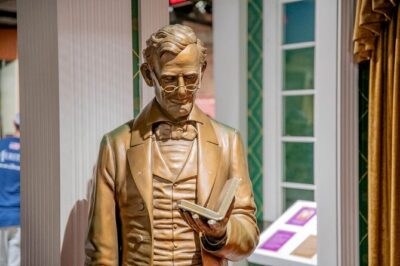
Lincoln Assassination with Ford’s Theatre & Petersen House Entry
Read our review →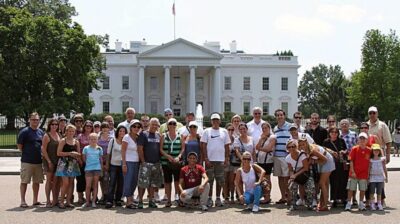
White House, National Mall and Lincoln Memorial Tour
Read our review →
Bike Tour: Capitol Hill, Lincoln Memorial, National Mall
Read our review →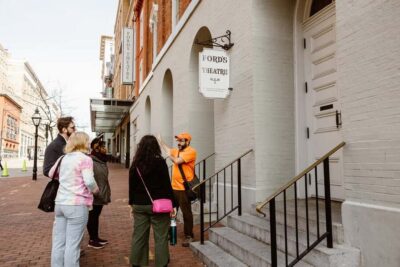
Lincoln’s Assassination 2 Hour Nighttime Walking Tour
Read our review →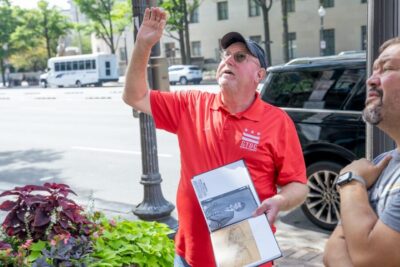
Lincoln Assassination Walking Tour with Ford’s Theatre
Read our review →
White House and National Mall Highlights with Lincoln Memorial
Read our review →
Washington D.C. Lincoln Assassination History Walking Tour
Read our review →Browse the lists this tour appears in